
Governance
Configure fix approvals, protected paths, and account settings in one place.
Research
A defensive analysis of Temporal CVE-2025-14986 and the difference between authorization scope and policy-evaluation scope.
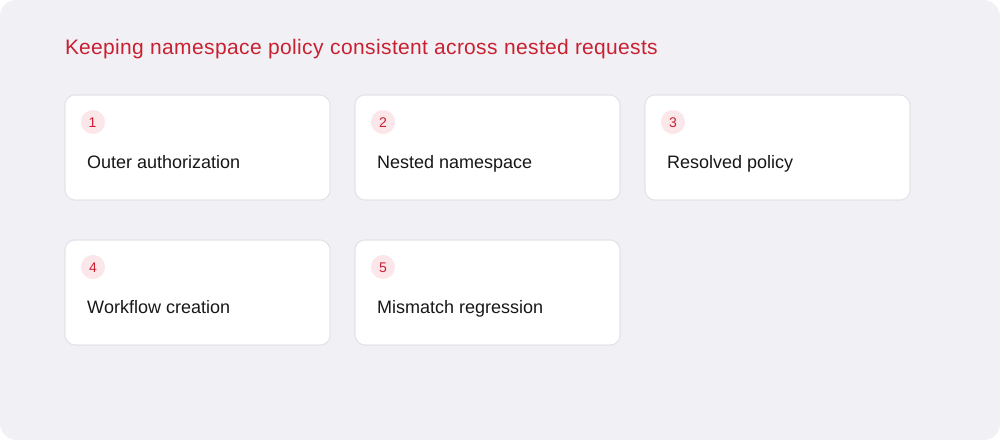
A compound API can contain an outer request and one or more embedded requests, each carrying a namespace or tenant identifier. If authorization uses one field while feature gates or limits use another, a caller may receive behavior that does not belong to the authorized context. The failure can be a policy inconsistency even without access to another tenant's data.
CVE-2025-14986 describes this distinction in Temporal's ExecuteMultiOperation path when the relevant feature is enabled. The advisory explains that a nested workflow-start namespace could influence validation or gating while the workflow was still created in the authorized outer namespace. It should not be rewritten as a general cross-namespace data-theft claim.
At a request boundary, decide which identifier establishes the operation's authority and how embedded requests must relate to it. Either normalize nested fields to the authorized context or reject a mismatch according to the API contract. Every downstream policy check should receive the same resolved context rather than selecting a convenient field independently.
This principle applies to tenant limits, feature availability, retention rules, routing, and resource quotas as well as access checks. A request can pass authentication and ownership validation yet still be processed under the wrong operational policy. Review those decisions as separate but coordinated parts of the security boundary.
Map the outer authorization step, nested request parsing, policy evaluation, and eventual state change. Look for helpers that reload configuration using a nested identifier or substitute a default when a field is empty. Error handling and retries can also reconstruct context differently from the initial request.
For a compound operation, verify that each sub-operation inherits or explicitly validates the established scope. Do not assume that checking the outer envelope once makes every nested field trustworthy. Record the resolved context in structured diagnostic evidence without exposing sensitive request content, so a reviewer can see which policy actually governed the operation.
Create isolated namespaces with intentionally different non-sensitive limits or feature settings. Exercise matching identifiers, omitted nested identifiers, and mismatched nested identifiers. The expected result should be either a clear rejection or consistent processing under the authorized namespace, according to the documented contract.
Assert both policy behavior and the location of any resulting resource. A test that checks only where the workflow appears can miss a gating bypass, while a test that checks only an error message can miss an unintended state transition. Include retries and equivalent compound APIs to prevent the same inconsistency from surviving in a neighboring path.
The public advisory lists fixed Temporal server releases 1.27.4, 1.28.2, and 1.29.2 for the affected branches. These are fix boundaries for this historical issue, not a complete current upgrade recommendation. Verify the maintained server release and the enabled feature configuration in the actual deployment.
After rollout, rerun the namespace-policy regression and inspect whether all frontend instances use the repaired behavior. Review relevant operation history if there is evidence that inconsistent policy was previously exercised, while keeping conclusions proportional to the advisory's scope. Accurate remediation distinguishes a policy bypass from a different authorization failure instead of enlarging the claim to make the finding sound more severe.
Configure fix approvals, protected paths, and account settings in one place.

Review findings and fix activity in one place, with finding exports available.

Review recorded scan activity and finding state changes.

Account membership controls access to connected repositories and findings.
Bring your own encryption key. Your data stays encrypted with keys you control.