
Governance
Configure fix approvals, protected paths, and account settings in one place.
Research
How to prepare a reproducible report, work with maintainers, and publish defensively useful information without inventing a standing company policy.
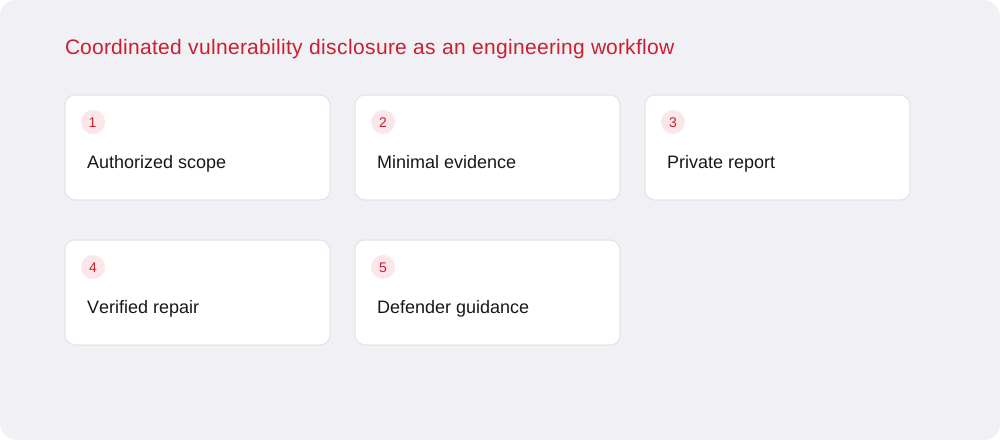
A disclosure process begins before a report is written. Define the systems you are authorized to assess, the kinds of testing permitted, and the information you may handle. An interesting technical question does not automatically authorize accessing another person's data or extending a test into a production environment.
Use the project's published security instructions to find the correct reporting channel and any scope or handling requirements. If the project supports private vulnerability reporting, prefer that channel for details that could expose users before a fix is available. Public issue trackers and general support channels may not provide the same confidentiality or routing.
A useful report identifies the affected component and revision, the security property that fails, and the conditions needed to reproduce it. Include an isolated, minimal test case and an explanation of expected versus observed behavior. Avoid attaching production credentials, private customer data, or a large unfiltered log archive when a smaller artifact demonstrates the issue.
Distinguish confirmed observations from hypotheses about broader impact. If a crash is reproducible but code execution has not been established, say so. If a configuration prerequisite is unknown, identify it as an open question rather than smoothing it into a stronger headline. Precision reduces both triage time and unnecessary alarm.
Agree on a communication path and track acknowledgment, technical validation, fix development, release preparation, and user notification. Timing can depend on downstream packages and deployment complexity, so make the assumptions visible rather than treating a single deadline as a substitute for coordination.
Keep a dated record of material decisions and the artifacts used to validate them. Share new evidence when it changes the assessed impact or affected scope. If communication stalls, seek an appropriate coordination channel instead of escalating through unrelated public audiences. The objective is a reliable repair and informed users, not a contest over who controls a narrative.
A patch should address the violated invariant and cover equivalent paths, not only one demonstrated input. Rerun the original reproducer against the proposed fix, inspect neighboring cases, and confirm that supported ordinary behavior remains intact. Record the exact fixed revision so the finding can be connected to released artifacts.
Coordinate identifiers, advisory language, and credit accurately with the maintainers. An assigned identifier is a reference to a published vulnerability record, not proof that every downstream installation is exploitable. Preserve the distinction between affected library versions, reachable application paths, and observed incidents when describing the repair.
A useful public write-up explains impact, prerequisites, supported remediation, and how operators can verify that the fix is deployed. Consider which technical details are needed for defense and which would add risk without helping affected users. Link to the authoritative vendor advisory and correct the article if later evidence changes its scope.
This article is an educational workflow, not a promise of a particular Counterswarm bounty, disclosure deadline, safe-harbor agreement, or vulnerability-response service. Those commitments need an explicit published policy and the capacity to honor it. Clear boundaries and accurate reporting are more useful than borrowing another organization's policy or announcing commitments that have not been established.
Configure fix approvals, protected paths, and account settings in one place.

Review findings and fix activity in one place, with finding exports available.

Review recorded scan activity and finding state changes.

Account membership controls access to connected repositories and findings.

Bring your own encryption key. Your data stays encrypted with keys you control.