
Governance
Configure fix approvals, protected paths, and account settings in one place.
Research
A configuration-aware response guide for CVE-2026-42945 that separates the library condition from deployment-specific impact.
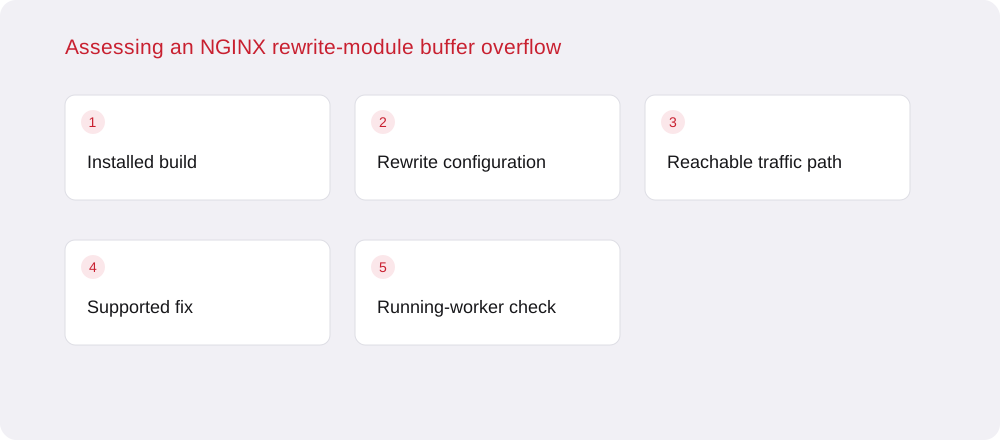
NGINX's security-advisory list identifies CVE-2026-42945 as a buffer overflow in the rewrite module. It lists 0.6.27 through 1.30.0 as vulnerable upstream versions and 1.30.1 and 1.31.0 as the initial fixed release boundaries. The advisory labels the issue medium severity; an application assessment should not replace that with an unsupported universal impact claim.
Those version numbers are historical reference points, not a reason to stop updating. Determine the maintained release appropriate to the deployment and check distribution or product-vendor guidance where patches may be backported. A package version string by itself may not describe the complete security state of a vendor build.
Rewrite handling translates request-derived values into new internal strings. When a transformation calculates an output length and later writes the output, both stages must agree about escaping and expansion. A mismatch can allocate less space than the later write requires, even when each stage appears reasonable in isolation.
For deployment review, identify rewrite directives and surrounding configuration that exercise the affected behavior. Include generated configuration and included files, not only the main configuration template. A scanner that recognizes the server banner has not yet established that the relevant processing path is reachable in that installation.
NGINX may appear as a direct web server, reverse proxy, ingress component, sidecar, or vendor-managed appliance. The component that terminates a public connection is not necessarily the one that executes a particular rewrite rule. Map how requests move through each layer and identify which binaries and configurations belong to each hop.
Keep upstream open-source version guidance separate from product-specific release guidance. A third-party integration may bundle or patch the engine differently. Collect the installed build information and the vendor's applicable advisory rather than translating an upstream version boundary into an unverified statement about every related product.
Prefer upgrading to a supported fixed build and testing representative routing behavior in staging. Confirm that ordinary redirects, query strings, encoded characters, and application paths still behave as expected. If a temporary configuration change is required, assess its functional consequences and obtain the appropriate vendor guidance for that environment.
Use isolated negative tests and instrumentation where available. A failed request or a worker restart can have many causes and is not by itself a reliable vulnerability diagnosis. Preserve configuration identity and logs so a result can be tied to the affected module and build rather than to a transient application error.
Reloading configuration and replacing a binary are different operations. Verify that all traffic-handling workers run the intended patched build and that stale replicas or immutable images have been replaced. Check generated configuration again after orchestration reconciles the deployment, because manual changes may not survive the next rollout.
Prioritize exposure using the actual request path, worker privileges, and operational impact. Separate possible memory corruption from confirmed application effects and observed malicious activity. This guide provides a defensive response method based on upstream information; it does not claim discovery, a working exploit, or knowledge of compromise in any particular installation.
Configure fix approvals, protected paths, and account settings in one place.

Review findings and fix activity in one place, with finding exports available.

Review recorded scan activity and finding state changes.

Account membership controls access to connected repositories and findings.

Bring your own encryption key. Your data stays encrypted with keys you control.