Governance
Configure fix approvals, protected paths, and account settings in one place.
Research
How to assess a dependency finding across repository input, notebook processing, native code, and deployment versions.
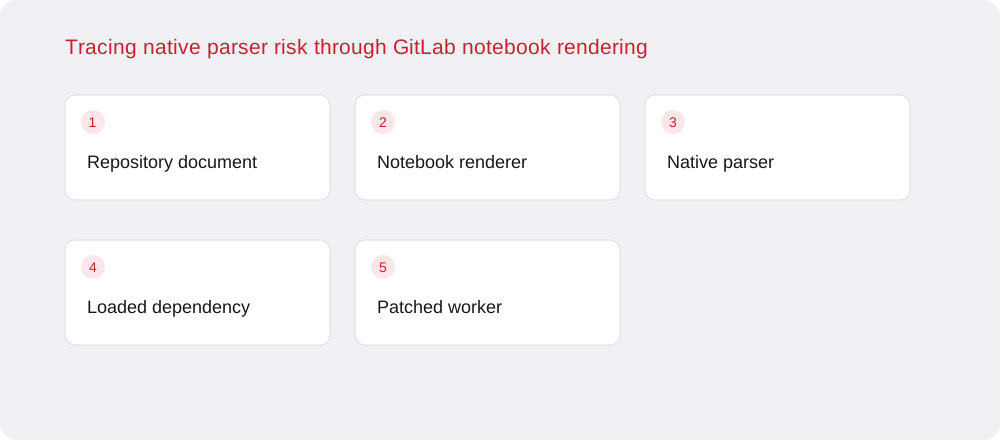
A repository platform processes more than source text. Previewing notebooks, generating diffs, extracting metadata, and rendering attachments can invoke parsers inside long-running application workers. The security review starts by identifying which repository-controlled bytes reach those operations and under what permissions.
For a notebook path, trace the uploaded or committed document through format recognition and transformation to the JSON implementation that ultimately parses it. A high-level call can conceal native code underneath. Record whether rendering happens immediately, in a background job, or only after another user opens a view, because those differences change the exposure and response plan.
A parser needs clear bounds for nesting, lengths, and buffer growth. Review how it rejects unsupported depth and how it represents values that may be larger than a narrow integer field. The relevant question is whether the parser can prove that each write fits the allocation under all accepted inputs, including error handling.
The Oj upstream change ec368dbe addresses parser handling around nesting and key lengths. Use the code and its tests to identify the repaired contract rather than inheriting a downstream article's claimed exploit chain. A dependency patch can be important even when a complete application-level exploit has not been established in the environment being assessed.
Check the deployed application's bundled gem lockfile and loaded extension, not only a repository manifest. Container layers, package caches, and multiple worker images can leave different revisions running concurrently. Verify the application's version independently from an orchestration chart or operator version, which may use a separate numbering scheme.
GitLab's June 2026 patch-release page documents releases 19.0.2, 18.11.5, and 18.10.8. That historical release information is a useful reference, not a claim that those versions are currently the best supported choice. Follow current vendor maintenance guidance and confirm the dependency revision in the installed release.
A safe validation environment should contain representative configuration and the relevant rendering path without production credentials or repositories. Begin with ordinary notebooks and controlled malformed documents, then observe parser rejection, worker health, and error reporting. Limit runtime and resource consumption so a failed parser cannot disrupt shared development infrastructure.
Preserve the request path, authentication role, target build, and logs needed to reproduce the result. A standalone library failure and an application worker failure are different evidence levels. If the application rejects the document before it reaches the parser, record that boundary instead of bypassing it silently and calling the production workflow affected.
Rebuild and restart every worker that loads the native dependency, then rerun both the negative regression and ordinary document operations. Check that cached previews or background jobs do not reintroduce an old execution path. A repaired lockfile without a refreshed runtime is incomplete deployment evidence.
If a vulnerable path was exposed, incident assessment should consider the worker's authority over credentials, storage, and internal services. Separate possible consequences from observed activity. This article makes no discovery or coordinated-disclosure claim on behalf of Counterswarm; it provides a way to connect upstream parser changes to a defensible conclusion about a particular GitLab deployment.
Configure fix approvals, protected paths, and account settings in one place.

Review findings and fix activity in one place, with finding exports available.

Review recorded scan activity and finding state changes.
Account membership controls access to connected repositories and findings.
Bring your own encryption key. Your data stays encrypted with keys you control.