
Governance
Configure fix approvals, protected paths, and account settings in one place.
Research
A defensive guide to separating engine memory safety, in-process confinement, and browser-process isolation.
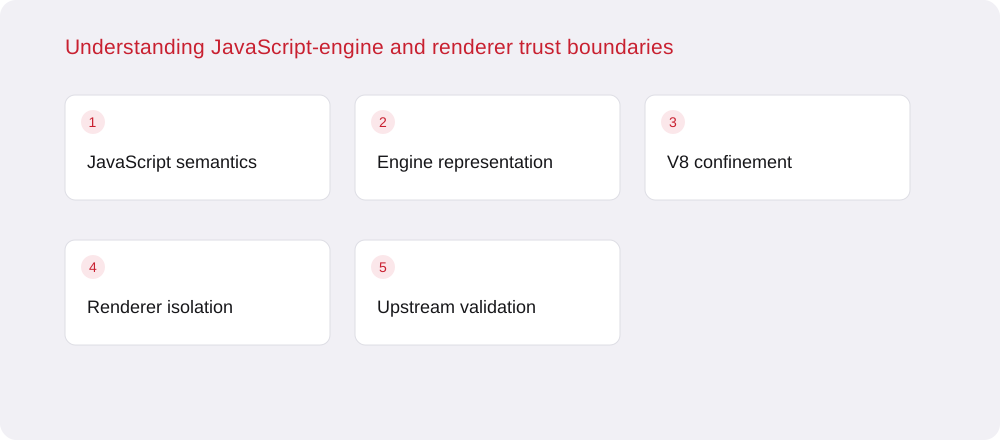
A browser runs code from origins that it cannot assume are trustworthy. Security depends on several layers: language semantics, the engine's implementation, restrictions inside the renderer, and the boundary between that renderer and more privileged browser components. A finding at one layer should be described in terms of the boundary it actually crosses.
V8's sandbox design explains an additional in-process boundary intended to constrain corruption of memory associated with the engine. That is different from the operating-system sandbox around a renderer process. A bug that affects JavaScript object representation does not automatically establish an escape from either boundary.
Modern engines specialize code based on observed types, object shapes, and other runtime facts. Correctness requires those assumptions to remain valid when execution transitions between optimized code, runtime helpers, and exceptional paths. Defensive review asks where a value's representation or lifetime can change without the consumer being informed.
Use small semantic tests to compare behavior across execution modes and optimization transitions. A surprising result may be a language-level correctness issue, an engine assertion failure, or memory corruption. Preserve that distinction until instrumentation and debugging evidence establish which invariant failed and where the failure occurred.
An engine reproducer depends on the exact revision, build flags, architecture, and enabled defenses. A debug assertion, sanitizer trace, and release-build crash can provide different information about the same input. Record those conditions so a maintainer can reproduce the observation and distinguish a fixed issue from an unrelated regression.
Avoid using success in a challenge configuration as proof of exposure in a maintained browser release. Challenge environments may intentionally change defenses or freeze an older revision. Translate any result into the product's actual build and threat model before presenting it as a deployed security impact.
A patch should restore the violated assumption, not simply recognize one observed input. Regression tests need nearby transitions: alternate object states, exception handling, allocation pressure, and optimization or deoptimization where relevant. The test should make the semantic or memory-safety property clear enough that a future refactor does not accidentally remove its purpose.
Combine a narrow reproducer with broader engine test suites and fuzzing. Deduplicate crashes by root cause rather than by their external symptom alone. Several crashes can arise from one representation error, while two similar-looking failures may require different fixes. Keep each finding's evidence and affected revisions explicit.
V8 directs security reports through Chromium's security process. Follow the project's current reporting instructions and avoid disclosing sensitive reproduction details publicly before the maintainers have an opportunity to assess them. Share the minimum relevant environment and evidence through the appropriate channel.
For operators, browser and embedded-engine updates should be verified in the actual applications that load them. Updating a standalone browser does not update every packaged desktop application or service runtime. This guide explains boundaries and defensive validation; it does not assert newly discovered engine vulnerabilities, challenge awards, or a transferable renderer-exploitation result.
Configure fix approvals, protected paths, and account settings in one place.

Review findings and fix activity in one place, with finding exports available.

Review recorded scan activity and finding state changes.

Account membership controls access to connected repositories and findings.

Bring your own encryption key. Your data stays encrypted with keys you control.