
Governance
Configure fix approvals, protected paths, and account settings in one place.
Research
A defensive review of Netty CVE-2025-59419 and why every protocol field needs an explicit encoding contract.
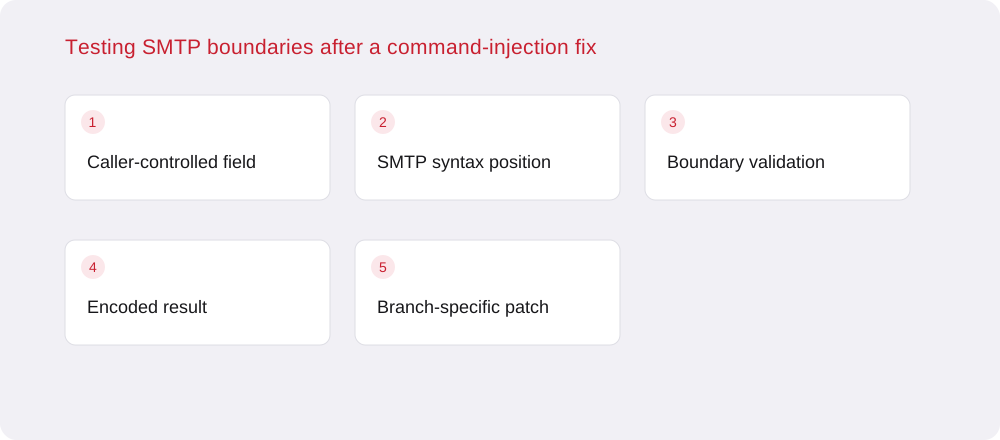
SMTP uses line boundaries to distinguish commands and parameters. If an application places untrusted text into that syntax without validating the relevant control characters, a value intended to describe one recipient can alter how the server interprets the command stream. Authentication of the application does not correct that serialization mistake.
CVE-2025-59419 concerns parameter handling in Netty's SMTP codec. The upstream advisory identifies a missing carriage-return and line-feed check in user-supplied SMTP parameters. It lists 4.1.128.Final and 4.2.7.Final as the initial patched versions for that issue. Those historical boundaries do not establish that an old release contains every later security fix.
A review should distinguish command names, addresses, optional parameters, and message content. A validator appropriate for one position may be incomplete for another. Identify which fields an external caller can control and whether each is passed through a structured API or assembled into a raw protocol line.
The security contract needs to hold at the encoding boundary. Checking only a web form is insufficient if background jobs or internal APIs construct the same SMTP request differently. Keep validation close enough to serialization that alternative callers cannot bypass the intended rule accidentally.
A later Netty advisory, GHSA-5vh9-c45f-rf7p, describes a command-name field not covered by the earlier parameter-oriented repair. This is a useful example of fix completeness: the original field can become safe while a related construction path retains the same class of weakness. The later advisory also explains that reachability depends on an application letting untrusted input select a command name.
That distinction matters. A dynamic recipient address is common, while a user-controlled protocol verb may be absent in a normal application. Record the actual input path instead of presenting every theoretical codec entry point as an equally exposed production vulnerability.
Use an isolated codec test or a controlled mail-testing service rather than sending messages to real recipients. A negative case should verify rejection before untrusted data changes the protocol structure. Include parameter and command construction paths, empty values, Unicode handling, and normal valid addresses.
Inspect the serialized result or explicit exception, not just a high-level success status. A test that merely confirms an email job failed could be passing because of DNS, credentials, or an unrelated service outage. Preserve ordinary message behavior so the repair does not break legitimate address formats without an intentional product decision.
Check the dependency actually loaded by every service and worker that sends mail. Direct dependency declarations can miss an older transitive or shaded copy of the codec. Prefer a maintained supported release and verify the applicable advisories for its branch rather than pinning indefinitely to the first version that addressed one report.
Assess possible exposure according to the application's authority: allowed sender identities, relay permissions, and access to recipient data. Protocol injection can undermine assumptions about trusted mail flow, but the exact consequences depend on that environment. Keep the investigation focused on defensive validation and accurate impact, rather than using a successful codec demonstration as proof of a broader compromise.
Configure fix approvals, protected paths, and account settings in one place.

Review findings and fix activity in one place, with finding exports available.

Review recorded scan activity and finding state changes.

Account membership controls access to connected repositories and findings.

Bring your own encryption key. Your data stays encrypted with keys you control.