Governance
Configure fix approvals, protected paths, and account settings in one place.
Research
A defensive patch-review guide using the public Swetrix upload-path issue, CVE-2025-59304, as a concrete example.
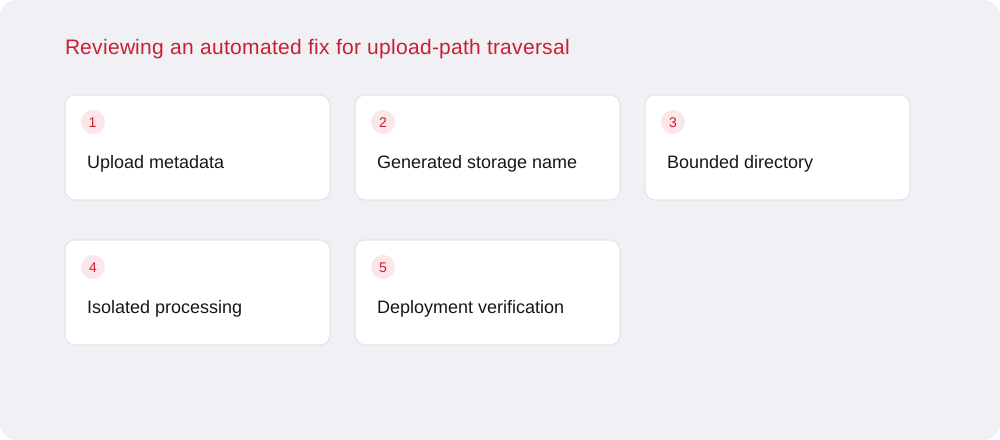
An upload service needs a destination filename, but a client-provided name should not decide where the server writes. CVE-2025-59304 concerns a Swetrix upload path that used an untrusted original filename when constructing a temporary filesystem path. The upstream repair replaces that naming decision with a generated identifier.
The general lesson is broader than a particular string pattern. Treat the submitted name as display metadata rather than a filesystem capability. A caller who may upload content does not thereby receive permission to choose a parent directory, replace an application file, or control how that file will later be executed.
Follow the upload from request parsing through temporary storage, conversion, persistence, and download. A safe temporary name can still be undermined by a later rename that restores an unsafe path. Archive extraction, image transformation, and cleanup routines may introduce additional naming decisions outside the original endpoint.
Document ownership and permissions for every directory involved. The service should not be able to overwrite application code or sensitive configuration as part of an ordinary upload. Store untrusted content outside executable paths and use separate processes where processing requires more complex parsers or elevated access.
The public Swetrix change introduces UUID-based filenames while retaining extension handling. That addresses the specific decision to trust the original name. A reviewer still needs to consider whether an extension is required, how it is validated, and whether another component interprets it as an instruction about executable content.
A generated patch should explain its invariant: the resolved storage destination is created by the application within an approved directory. Review errors, cleanup, concurrency, and return values against that invariant. A plausible patch description or a green unit test is not sufficient evidence that every path uses the new naming rule.
In a temporary isolated directory, test names containing separators, unusual Unicode, repeated dots, empty values, and platform-specific path syntax. Assert where the file was actually created, not merely what name the API returned. Include interrupted writes and collisions or retries to check that cleanup cannot remove another request's artifact.
Positive tests should preserve supported file types and the original user-facing display name where the product requires it. The secure behavior should not silently corrupt metadata or make normal downloads unusable. Keep regression cases at the storage boundary so they continue to protect future upload entry points.
The upstream pull request is useful evidence of the code change, but a deployment needs its own verification. Identify the merged revision included in the built application, restart relevant workers, and confirm that old writable artifacts are not still served or executed. Dependency scanners and branch names alone may not reveal whether the repaired code is running.
If an unsafe upload endpoint was exposed, assess possible file modification and affected credentials separately from patch validation. Preserve evidence before cleanup. This guide does not claim authorship of the original discovery or patch; it describes how to evaluate and deploy a narrowly scoped repair responsibly.
Configure fix approvals, protected paths, and account settings in one place.

Review findings and fix activity in one place, with finding exports available.

Review recorded scan activity and finding state changes.
Account membership controls access to connected repositories and findings.
Bring your own encryption key. Your data stays encrypted with keys you control.