
Governance
Configure fix approvals, protected paths, and account settings in one place.
Security commentary
Trace PHP runtime exposure, verify vendor fixes and close the gap between a package update and a protected service.
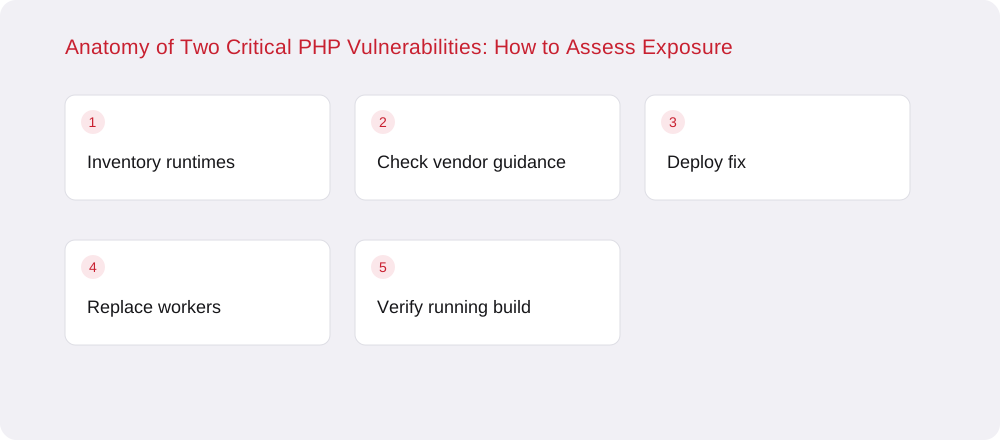
A PHP vulnerability can affect a custom application, an administrative service or a container image even when the organisation does not operate a familiar PHP-based content management system. Inventory the runtime that actually handles requests. Include service processes, base images, hosting platforms and third-party software that bundles PHP. Searching application dependency manifests alone can miss a runtime installed by an operating-system package or inherited from an image.
The PHP project's October 2026 advisory describes two critical issues, CVE-2026-109618 and CVE-2026-109619, affecting request handling. Use that upstream advisory and your package vendor's guidance as the authority for affected builds and fixes. The operational lessons also apply when the next runtime advisory arrives.
The first issue concerns request cleanup after an out-of-memory condition leaves internal data incompletely initialised. The second concerns stale internal state whose backing memory has been released. Both illustrate why an application-level review cannot fully establish the safety of the runtime executing it. If failure occurs in request processing outside the application's normal logic, a patch to a controller or form validator may not address the underlying defect.
For exposure assessment, record how PHP is served, which package build is installed and which workers are active. A version string from a command-line shell may describe a different binary from the one serving traffic. Distribution backports can also make a simple upstream version comparison incomplete; preserve the vendor's package and advisory evidence.
Build an explicit change plan: identify the service owner, select a supported patched package or image, test application compatibility and deploy through the normal release process. Replace running containers and restart or reload service workers as required by that platform. Updating files on disk does not by itself demonstrate that an already running process uses them. Verify the runtime from the deployed service context and retain the image digest or package build identifier.
Use a health check and a small set of important application flows to confirm that the update is operational. A successful deployment job is evidence of a completed job, not necessarily evidence that every instance received the update. Check replicas, scheduled jobs and older environments that can still receive traffic.
When an immediate update is not possible, consult the advisory for configuration-specific mitigations and document their limits. Reducing public access, constraining request sizes or disabling an affected feature may reduce exposure in a particular environment. Such controls should have an owner, a review date and a path to the vendor fix. Avoid translating a temporary configuration change into a blanket statement that the service is safe.
Keep the resulting inventory after the incident. Record runtime provenance, support status and the mechanism used to update each service. That makes the next advisory a targeted change exercise rather than a fresh discovery project. The useful outcome is not a count of scanned repositories; it is evidence that the processes serving the application are using an appropriately maintained runtime.
Configure fix approvals, protected paths, and account settings in one place.

Review findings and fix activity in one place, with finding exports available.

Review recorded scan activity and finding state changes.

Account membership controls access to connected repositories and findings.

Bring your own encryption key. Your data stays encrypted with keys you control.