
Governance
Configure fix approvals, protected paths, and account settings in one place.
Security commentary
Turn accessible AI capability into a measurable defensive workflow rather than another unverified alert stream.
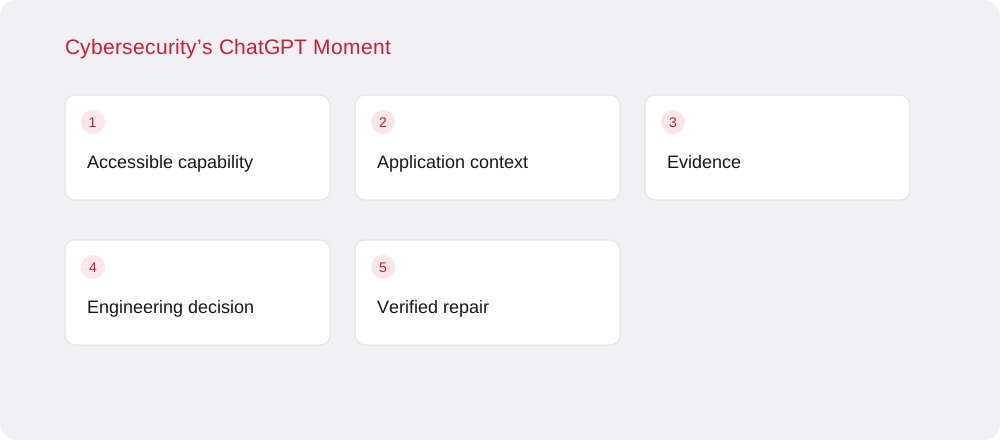
The phrase “ChatGPT moment” describes the point at which an unfamiliar capability becomes easy for many people to try. In cybersecurity, an accessible interface can make code explanation, test generation and evidence analysis available to a wider group of engineers. That accessibility matters, but it is not equivalent to dependable security coverage. A convincing demonstration may use a carefully selected example, while production work includes incomplete context, unfamiliar code and constraints that cannot be ignored.
Evaluate the operational change you want: reducing the time needed to understand a finding, identifying a missing permission check or retesting a repair. A narrowly defined improvement is easier to measure and adopt than a claim that AI replaces an entire security function.
An assistant can explain why a database query looks unsafe. A security workflow must also establish whether attacker-controlled input reaches it, which query interface is used and what protections apply. Preserve those assumptions alongside the proposed finding. When verification is appropriate, use an authorised test environment and a controlled input that demonstrates the security property without unnecessary access to data.
Make the evidence reviewable by someone who did not watch the agent work. Include source locations, the tested revision, relevant configuration and the observed result. If a tool failed or the environment was incomplete, say so. A report that accurately marks its limits is more useful than a confident verdict built on missing context.
Static analysis, dependency inventories, code review and runtime testing answer different questions. AI reasoning can help connect their outputs, but it should not erase the distinction between them. A data-flow query may identify a suspicious path; a deployment check may show that the component is absent from production; an authorisation test may uncover a business-rule failure that neither observation answers alone.
Choose an integration point that engineers already use, such as a pull request or an issue tracker. Present the specific condition that needs attention and a proposed next step. Avoid making developers navigate a separate wall of model-generated prose just to discover which file or permission boundary is involved.
Build a small evaluation set from representative, authorised cases. Include issues the current process detects, issues it misses and examples that should not produce a finding. Review false positives and omissions separately. Measure the engineering effort needed to reach a decision, not merely the number of observations the model emits. A workflow that creates more alerts without improving decisions has not solved the operational problem.
After rollout, follow findings through ownership, repair and retesting. Keep an easy way to challenge an incorrect conclusion and feed the correction back into the evaluation set. Accessible AI becomes valuable defence when it helps teams act on trustworthy evidence, while preserving accountability for the changes made to real systems.
Configure fix approvals, protected paths, and account settings in one place.

Review findings and fix activity in one place, with finding exports available.

Review recorded scan activity and finding state changes.

Account membership controls access to connected repositories and findings.

Bring your own encryption key. Your data stays encrypted with keys you control.