
Governance
Configure fix approvals, protected paths, and account settings in one place.
Security commentary
How to prepare for attacks that can repeat, adapt and coordinate faster than a manual security queue.
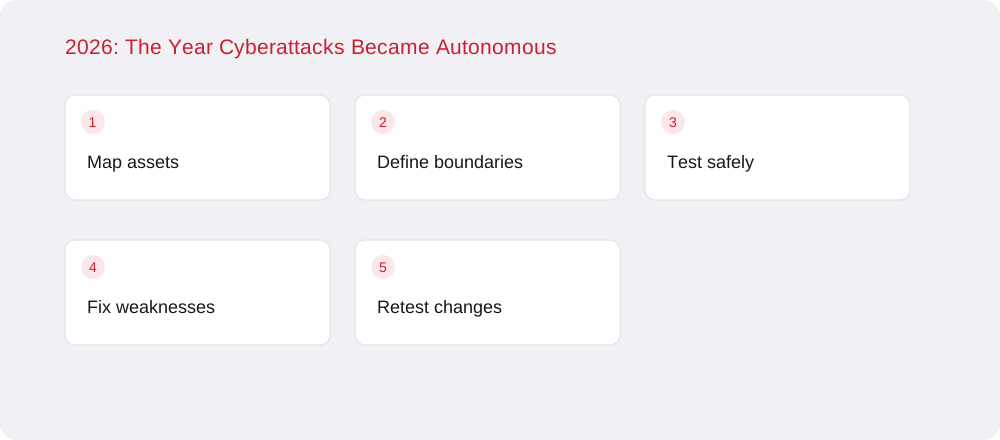
An autonomous attack does not require a new vulnerability class to become disruptive. A system that can repeatedly inspect exposed services, interpret responses and choose another step changes the workload defenders face. An individually modest weakness becomes more concerning when it can be tested across many assets. The practical question is therefore not whether an agent resembles a human expert. It is whether your organisation can detect and close the same gap before repeated attempts find a useful path.
Treat the title as a planning lens, rather than a claim that every incident is now autonomous. Build your response around observable actions, identities and exposed capabilities. Those remain useful signals regardless of who or what is generating the requests.
Start with the operations whose misuse would change a business outcome: exporting customer records, issuing a refund, changing access or publishing a build. Map each operation to its entry points, service identity and required permissions. Include background jobs, deployment hooks and administrative APIs. An authenticated request is not automatically an authorised operation. A low-privilege account may still reach an endpoint whose implementation trusts the wrong tenant identifier.
This map gives a security test a specific purpose. Instead of asking an agent to find anything interesting, ask whether a particular identity can cross a defined boundary. Use a test environment and synthetic records, and make the expected forbidden outcome explicit.
A finding should carry the affected revision, deployment context and evidence needed to reproduce the issue. A remediation ticket should identify the owner and the boundary being repaired. After a fix, replay the narrow test and check an adjacent legitimate workflow. A permission change that blocks every request may remove an exploit path while also breaking the product. Verification needs to establish both security and intended behaviour.
Run this cycle when relevant conditions change: a new endpoint, a dependency update, a permission change or a newly exposed environment. A calendar-based assessment can still add value, but it should not be the only trigger for reviewing a changing system.
Defensive automation also needs limits. Give testing identities only the access needed for the agreed scope, cap request rates, keep credentials short-lived and isolate generated test artefacts. Stop conditions should be enforced by the environment rather than left to a conversational instruction. Record which tool performed each action so a reviewer can distinguish an attempted request from a confirmed effect.
A useful weekly review is concrete: which critical operations were tested, which assets were omitted, which findings were fixed and which fixes were retested? Tracking those answers is more informative than counting agent actions. Continuous AI defence is a repeatable evidence-and-repair process, not a promise that automation eliminates risk.
For example, a newly exposed support export should trigger a review of its caller permissions, record selection and download destination. That focused change review can reveal a useful weakness without treating every new feature as an invitation for unrestricted testing.
Configure fix approvals, protected paths, and account settings in one place.

Review findings and fix activity in one place, with finding exports available.

Review recorded scan activity and finding state changes.

Account membership controls access to connected repositories and findings.

Bring your own encryption key. Your data stays encrypted with keys you control.